Most people hear the word “deficit” and immediately tune out. It sounds like a government accounting problem. It’s something for economists and politicians to argue about on cable news while the rest of us go about our lives.
Here’s what nobody tells you. The deficit isn’t just Washington’s problem, it’s yours too. The way it gets passed on to you isn’t through a tax bill or a letter in the mail. It’s quieter than that. It shows up in your grocery bill, your rent, and the raise that somehow still doesn’t feel like enough. Once you understand how deficits work, a lot of things that feel random about the economy start to make a whole lot more sense.
Two Deficits Worth Knowing
Before we get into what this means for you, let’s go over what a deficit actually is. The United States currently has two major deficits.
The first is the fiscal deficit. That’s when the federal government spends more money than it takes in from taxes in a given year.
Think about your own budget for a second. If you bring home $5,000 a month but spend $6,000, you’ve got a $1,000 deficit. The government works the same way, but with a lot more zeroes.
In 2025, the US had a fiscal deficit of $1.78 trillion. The US government spent $7.01 trillion and had a revenue of $5.23 trillion.
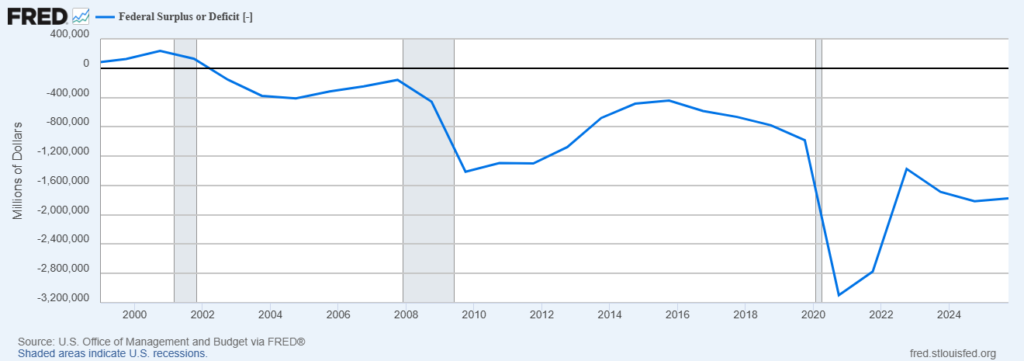
The second is the trade deficit. That’s when the US buys more goods and services from other countries than it sells to them. In other words, we’re importing more than we’re exporting.
In 2025, the US had a trade deficit of $901.5 billion.
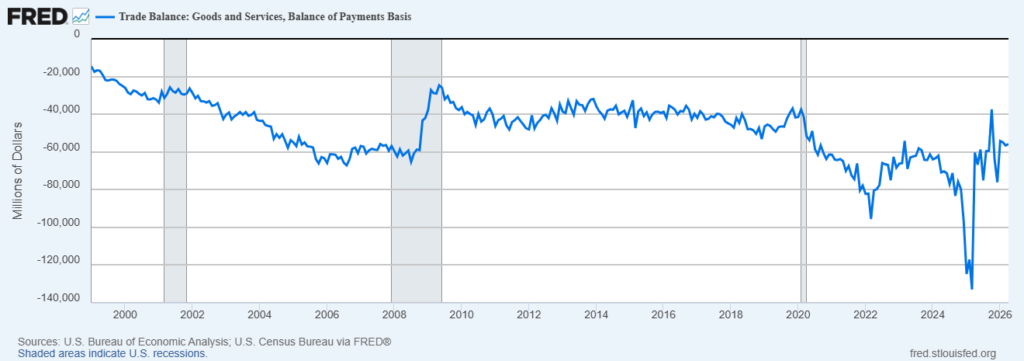
Both deficits matter. For this article though, I’m going to focus on the fiscal deficit. That’s where the story really gets interesting for the average American.
How Deficits Turn Into Debt
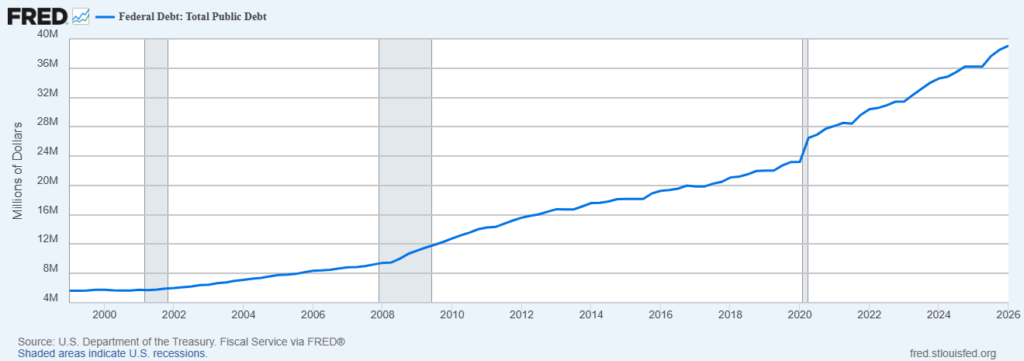
A deficit just doesn’t disappear at the end of the year. Every dollar the government overspends gets added to the national debt (the total amount the US government owes to everyone it’s borrowed from). So year after year, deficit after deficit, the national debt keeps climbing.
Right now the US national debt is over $39 trillion. The debt to GDP ratio (how much debt we’re carrying compared to the total size of our economy) is above 120%. That debt-to-GDP number matters more than the raw dollar figure. It tells you how heavy the debt load actually is relative to the ability to pay it back.
[Note: Internal link opportunity – fiscal dominance article if published]
Who Actually Pays for It
Here’s where it gets personal.
The US has to issue Treasury bonds in order to cover the gap between what it takes in from revenues versus how much it spends.
When you borrow money you have to pay interest on it (or else who is going to lend you money?). The government is no different. As the national debt has grown, so have the interest payments. This isn’t some future problem we’re kicking down the road anymore. It’s happening right now.
Interest payments on the national debt have become one of the biggest line items (individual spending categories) in the entire federal budget. We’re spending more on interest than on a lot of other major programs. When interest rates went up coming out of COVID, those payments got even bigger in a hurry.
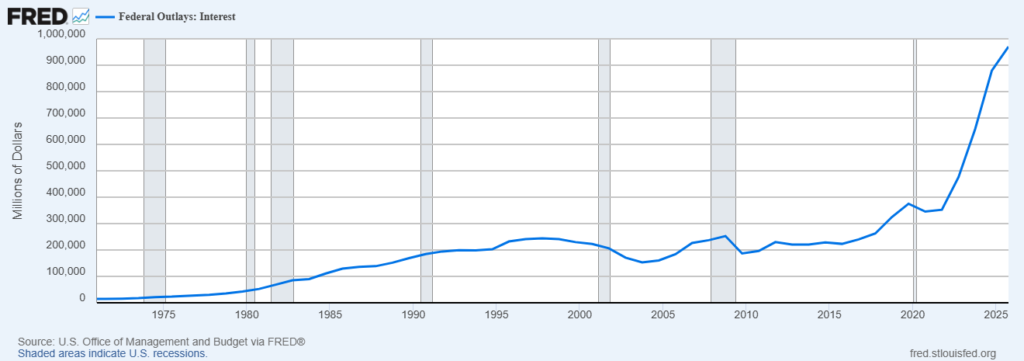
What that means is that the government has less room to spend on anything else. Every dollar that goes to interest is a dollar that can’t go to infrastructure, healthcare, or anything else you might actually want the government to spend money on. When things get tight, the government starts looking for ways to manage the burden.
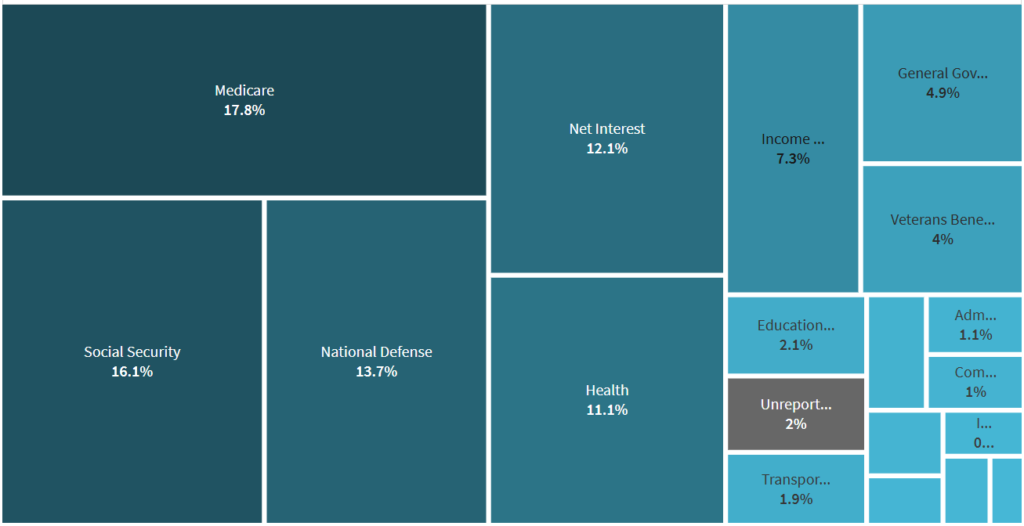
You can in the image above that interest payments represented 12.1% of all US government spending in the fiscal year 2025. The government spent more paying interest on the debt it owes than on education and veteran’s benefits. Think about that for a minute.
The Endgame: Fiscal Dominance
When interest payments get big enough, they start to crowd out everything else in the budget. At that point the government is looking at some pretty uncomfortable options. They can decide to raise taxes (no politician will do this), cut spending (again, not going to happen), or try a third option.
That third option is what’s called fiscal dominance. The way it works is through something called financial repression (a set of policies that keep interest rates artificially low to benefit borrowers like the government, at the expense of savers and regular people). Keep rates low so borrowing stays cheap. Let inflation run a little hotter than usual. Over time the real value of the debt shrinks because you’re paying it back with dollars that are worth less than the ones you borrowed.
Sounds like a neat trick for the government, but it’s not free. The cost gets passed on. Not through a tax bill, but through your purchasing power (what your money can actually buy in the real world) slowly eroding over time. Your savings account earns 0.5% while inflation runs at 4%. Your wages go up but somehow you still feel like you’re falling behind. That’s fiscal dominance doing its thing. The government is inflating the debt away and you’re picking up the tab.
If this is confusing, think of it like this. Say that you have a credit card and its interest rate is 25%. If you keep using it, pretty soon your monthly credit card payments are going to get expensive. More of your income is going to be used just to pay the interest payment.
But what if you had a 5% interest rate on your credit card? All of the sudden the monthly interest payment isn’t as expensive, and you have more money in your pocket to spend. More money to spend means higher inflation.
What This Means for You
The US hasn’t gone into full blown fiscal dominance mode yet. However, there are a few things to look out for in the future.
Make sure to pay attention to inflation and interest rates. As of May 2026, CPI inflation YoY is at 4.2%. The Federal Funds rate is at 3.50% – 3.75%.
If we start to see the Federal Reserve cutting interest rates while inflation is still above their 2% target, then something might be up.
Also, keep an eye on the Treasury auctions. Someone has to buy all the debt the US is issuing. If there are any problems during the auctions, that’s another clue that something isn’t quiet right.
The US government isn’t going to come out and say “we are doing fiscal dominance” because it would cause global chaos. However, the right clues will tell us if the US is headed that way.
Understanding all of this doesn’t make the problem go away, but it does change how you think about your money. If the US starts to slide into fiscal dominance, then we know that short-term interest rates are going to be lower, borrowing will be cheaper, and financial conditions will be looser.
You can read more about how I view investing in a high debt-to-gdp world.
When the rules of the game shift, the people who understand what’s actually happening are the ones who can plan around it.
Frequently Asked Questions
What is the difference between the deficit and the national debt?
The deficit is the gap between what the government spends and what it takes in from taxes in a single year. The national debt is the total amount the government has borrowed over all the years those deficits have stacked up. The deficit is the new charge you put on a credit card this month. The national debt is the total balance you owe across every month you’ve ever done that.
Why can’t the government just stop spending so much?
A huge chunk of federal spending is mandatory (meaning it’s required by law and can’t be cut without an act of Congress), including things like Social Security (retirement and disability payments for eligible Americans), Medicare (government health insurance for people 65 and older), and interest payments on the debt itself. Those aren’t easy to touch without serious consequences. The discretionary spending (the stuff Congress debates and votes on each year) that makes the news is actually a smaller piece of the pie than most people think.
How does the deficit affect everyday Americans?
Mostly through purchasing power (what your dollars can actually buy). When the government borrows heavily and eventually inflates the debt away, the cost shows up in rising prices, savings that don’t keep up with inflation, and wages that feel like they’re always a step behind. You don’t get a bill. You just notice that the same paycheck buys a little less than it did last year.
What is fiscal dominance?
Fiscal dominance is when the government’s debt load gets so big that it starts influencing monetary policy (how the Federal Reserve manages interest rates and the money supply). Instead of the Fed setting rates based on what the economy actually needs, rates get kept artificially low to make the debt manageable. Inflation is allowed to run hotter than normal to slowly shrink the real value of what’s owed. The average American ends up paying the cost through purchasing power loss rather than a tax hike.
Is the US going to default on its debt?
A traditional default (flat out refusing to pay back what you owe) is unlikely. The US can always create more dollars to pay its obligations. There’s a quieter kind of default that’s a lot more likely though. When the government inflates the debt away, the people who bought Treasury bonds (government IOUs) get paid back with dollars that are worth less than the ones they lent.