How We Got Here · Part 1
If you’re an average American right now, the economy probably feels broken.
The stock market keeps hitting all-time highs, yet wealth inequality is the widest it’s been in more than three decades. The richest 10% have more wealth than the bottom 90%.
Meanwhile, it’s getting harder for the average American to just stay afloat financially. Forget actually trying to get ahead. Childcare, healthcare, and even a roll of ground beef at the grocery store is becoming too expensive.
Potential home buyers have to decide whether to go into hundreds of thousands of dollars of debt in order to be able to purchase a home or rent a place and own nothing.
So how did we get here?
Here’s my thesis: once you actually look at the economic history of America and how the system was built, the situation we’re in stops being surprising.
This isn’t a bug. It’s a feature.
The economy is operating exactly the way it was designed to. The problem is that almost nobody was ever taught how that design works. I’m going to help walk you through the story of how we got here in the first place.
Prefer to watch? The full breakdown is right here. The article below is the same story, built to read and to skim.
We could start this story almost anywhere in American history, but I’m starting at Bretton Woods because that’s where the modern monetary and economic system we still live inside today was actually built.
Inside the Room: The Bretton Woods Conference, 1944
In 1944, with World War II still grinding on but the end in sight, delegations from the Allied nations gathered at a resort in Bretton Woods, New Hampshire. Their job was to design the post-war world.
They had to answer the questions: What would the global economy look like? What would the rules be? Who would be in charge of what? What money would we use, and how would we make sure everyone was trading fairly?
Two ghosts were in the room with them. The first was the hyperinflation that wrecked Germany after World War I (the kind where your paycheck is worthless by the time it hits your hand). If you thought 2022 inflation was bad, it was nothing compared to the inflation in Germany.
The second was the Great Depression, where the Federal Reserve sat on its hands and let deflation spiral. So the thinkers at Bretton Woods leaned hard toward more government intervention, not less. They wanted tools to stop both disasters from repeating.
Keynes, the bancor, and the idea that lost
One of the giants in that room was John Maynard Keynes.
Keynes had a genuinely different vision. He wanted a world reserve currency he called the bancor. This would be a currency not controlled by any single country, and nations would settle trade in bancor instead of relying on anyone’s national money. He was obsessed with trade equilibrium: the idea that surplus countries (the ones taking in more than they give out) shouldn’t just hoard their wealth, but recycle it into deficit countries, so no nation drifts to an extreme. Balance instead of imbalance.
It was a thoughtful idea. It also lost.
Why the US had all the leverage
However, there was a problem with Keynes’s plan: by 1944, Britain wasn’t the superpower anymore. The British Empire had been deteriorating for years and the war had gutted it. The rising power was America, and on the American side, a man named Harry Dexter White was pushing hard to get what the US wanted.
And the US had the leverage to get it.
There were three reasons why America had all the leverage:
The first was that the US infrastructure was still intact. The allied countries such as Britain, France, and the Soviet Union had been decimated by the Nazis. Their cities, factories, and supply chains were bombed into rubble. The US was attacked at Pearl Harbor, but the mainland was unharmed. American cities, factories, and production plants were unharmed. The US started the post-war race miles ahead.
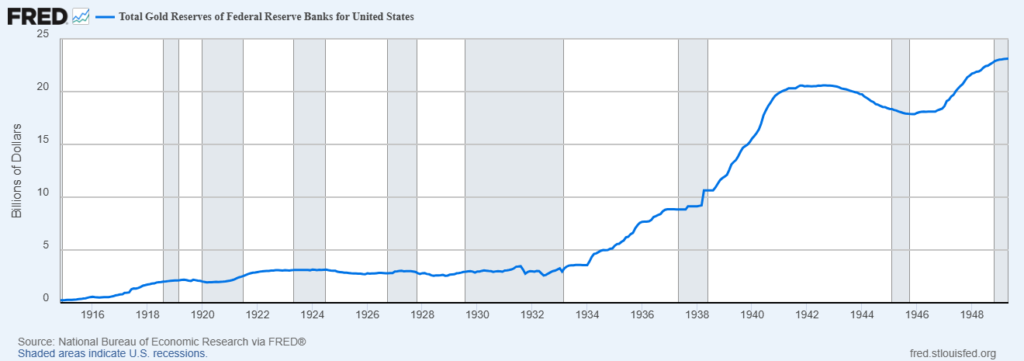
Second, America held two-thirds of the world’s gold reserves. As J.P. Morgan put it, gold is money, and the US had most of it.
Third, the US had the most powerful military at the time. American entry had turned the tide in both Europe and the Pacific. America could use even the threat of military intervention to make sure they got what they wanted.
So when all these allied nations sat down to decide the rules of the global economy, the outcome was almost predetermined. The United States won the argument.
What Bretton Woods actually produced
A few things came out of that agreement:
The US dollar would be backed by gold and every other country would now need dollars in order to trade.
The International Monetary Fund and the World Bank were created, institutions still around today that lend to and stabilize struggling countries and enforce the rules of the system.
But the single most important takeaway is this: after Bretton Woods, the United States became the backbone of the entire global financial system. From that point on, the world economy ran on what America wanted.
Here’s how it worked in practice. Say France wanted to rebuild after the war. They needed cement, tractors, machinery, etc in order to rebuild. France couldn’t just spend francs. They had to convert their francs into dollars, and then use those dollars to buy American goods, which got shipped back to France. Same story for the other allied nations. Everyone needed a stockpile of US dollars to function. This was very good for the American economy.
The first crack: the Soviet refusal
Not everyone signed on. The Soviet Union was invited, but flatly refused to ratify the agreement, join the IMF, or join the World Bank.
Why? Because they saw the whole thing as economic imperialism. Every other country was now dependent on the US dollar just to grow. You couldn’t rebuild your own country without American currency to buy American goods. The Soviets weren’t willing to make their economy hostage to that.
This was one of the very first splinters of the Cold War: the American capitalist system on one side, Soviet communism on the other, two completely incompatible ideas about how money and economies should be run.
Why America boomed after Bretton Woods
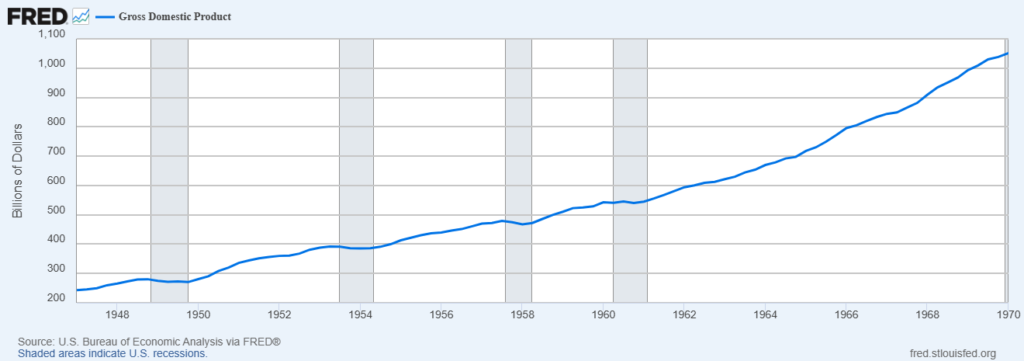
For the next two to three decades, the US economy went straight up and to the right.
The Dow Jones compounded at roughly 7% a year. GDP climbed relentlessly, recessions and all. Manufacturing employment grew steadily from 1946 onward. Two engines drove it: the baby boom flooding the workforce with new workers, and the simple fact that the rest of the world needed American goods to rebuild. The US wasn’t just a participant in the global economy, it was the production powerhouse at the center of it.
But nothing lasts forever.
The collapse (and where Part 2 picks up)
The Bretton Woods system held for almost 25 years before it started breaking down. America began spending a little too freely, and problems with the gold backing crept in. Other countries started doing the math and asking an obvious question: why would I keep holding US dollars when I could just take the gold instead? The exploits were beginning.
That’s where Part 2 comes in. I’ll explain why the system broke, what other countries started doing, and how it all fell apart until there was no more gold backing at all, replaced by the system we still live inside today.