We’re going to look at how different types of US equity styles have performed since 1972, when the US left the gold standard. This will give us a complete picture of how equities have performed during the fiat world reserve currency era.
Then, we’ll compare the returns to inflation and the money supply. Why those two? Because we need to see if these equity styles created real wealth over time.
By the end of this article, you’ll understand what the different US equity styles are, how they performed over the years, whether or not they created real wealth, and what questions you should ask yourself before investing.
A note on the data: Performance data before 1992 comes from theoretical academic research (the Fama-French Data Library), not actual investable funds. Real investors during that time used active managers like the Vanguard Windsor Fund, which came with fees and trading costs not reflected in this data. For Micro Cap specifically, data before 1981 is theoretical (CRSP Decile 10). From 1981 onward, it reflects actual net-of-fee performance from the DFA US Micro Cap Portfolio (DFSCX) — the first fund to make that category investable.
Key Takeaways
- Small Cap Value had the largest growth rate (CAGR) since 1972 at 13.41%.
- Small Cap Growth had the lowest at 9.77%.
- Each US equity style outperformed CPI and M2 money supply growth.
- Historical returns don’t tell the whole story. The economic era you’re investing in matters just as much.
What are US Equity Styles?
US equity styles sort stocks into groups based on size and style.
How do the size categories work?
Size is dependent on a company’s market cap (the total value of a company’s shares).
- US Market
- All public US companies, weighted by size.
- Large Caps
- Companies worth $10 billion or more. They make up roughly 70% to 80% of the market.
- Mid Caps
- Companies worth $2 billion to $10 billion. Many are well-known brands that haven’t gone global yet.
- Small Caps
- Younger or more niche companies worth $250 million to $2 billion.
- Micro Caps
- The smallest investable companies, under $250 million.
How Do The Styles Categories Work?
Value stocks look cheap compared to their true worth (like they’re on sale). They often pay dividends.
Growth stocks are fast risers and reinvest their profits into their business.
Historical CAGR by US Equity Style (Post-Gold Standard)
Here are the CAGR’s of each US Equity Style from 1972 to 2024.
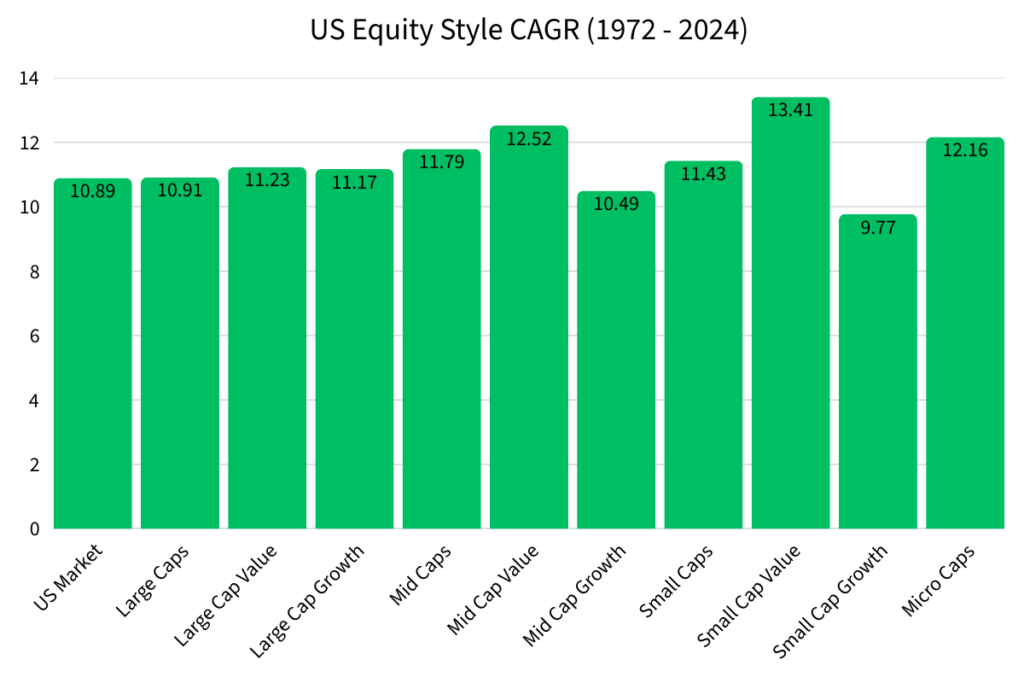
Small Cap Value had the highest CAGR at 13.41%. This is why many professionals still point to it as a strong long-term pick.
Small Cap Growth had the lowest CAGR at 9.77%. That 3.64% gap between Small Cap Value and Small Cap Growth might not sound like much, but wait until you see what it means in real dollars.
What Would $10,000 Look Like Today?
A small difference in two CAGRs might not seem like much, but when you compound it year after year the difference starts to stand out.
If you put $10,000 into each US equity style in 1972 and never touched it, here’s what you’d have in 2024:
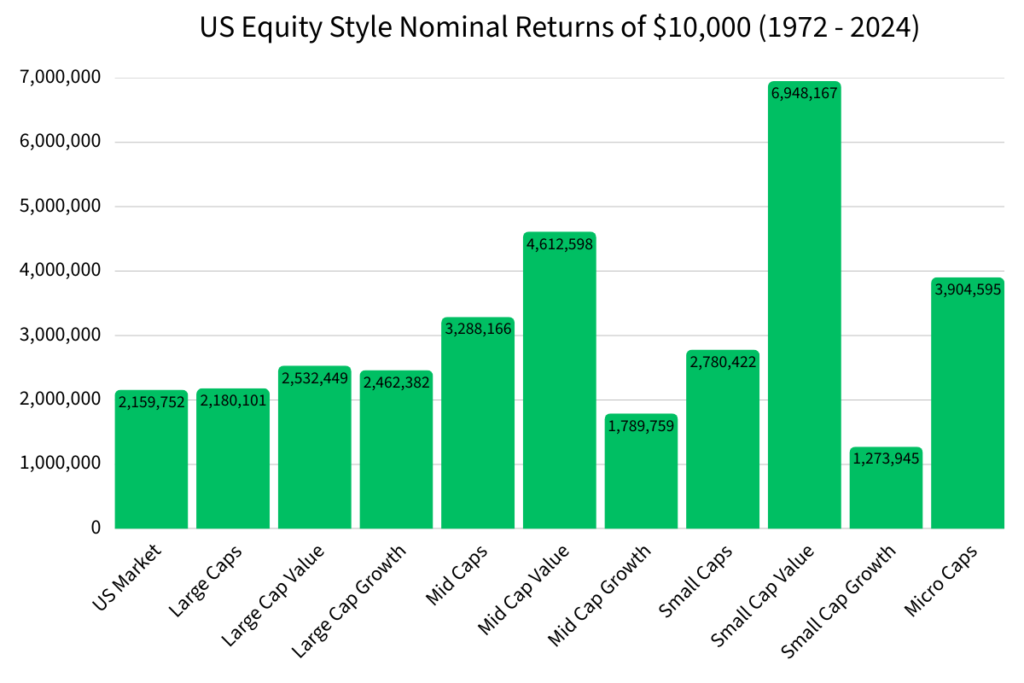
Look at Large Cap Growth (11.17% CAGR) versus the US Market (10.89% CAGR). That’s only a 0.28% difference. Barely anything, right?
Wrong. Over 52 years of compounding, that tiny gap turned into $302,630 more money.
For the average working person, $300,000 is life-changing. It’s the difference between retiring comfortably and working five more years.
This is why understanding your investments matters.
| US Equity Style (1972 to 2024) | CAGR | Nominal Return of $10,000 |
|---|---|---|
| Small Cap Value | 13.41% | $6,948,167 |
| Mid Cap Value | 12.52% | $4,612,598 |
| Micro Caps | 12.16% | $3,904,595 |
| Mid Caps | 11.79% | $3,288,166 |
| Small Caps | 11.43% | $2,780,422 |
| Large Cap Value | 11.23% | $2,532,449 |
| Large Cap Growth | 11.17% | $2,462,382 |
| Large Caps | 10.91% | $2,180,101 |
| US Market | 10.89% | $2,159,752 |
| Mid Cap Growth | 10.49% | $1,789,759 |
| Small Cap Growth | 9.77% | $1,273,945 |
Which US Equity Styles Beat The Market?
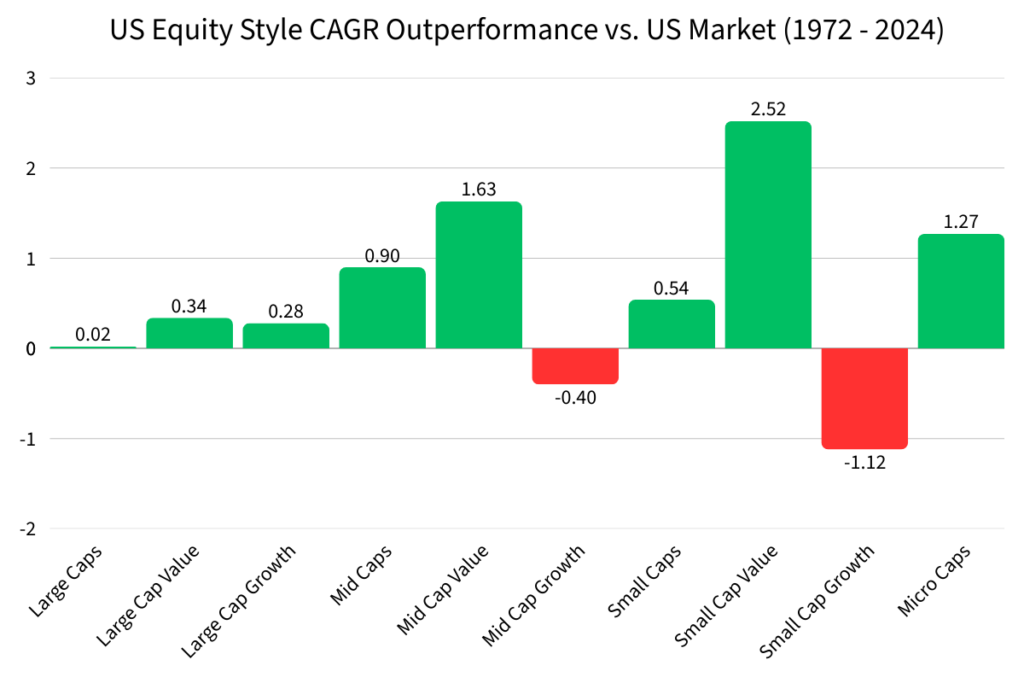
The US Market returned 10.89% per year. Most professional fund managers can’t beat that over a long time frame. Here’s how each equity style stacked up:
Styles That Beat the US Market
- Small Cap Value (+2.52%)
- Mid Cap Value (+1.63%)
- Micro Caps (+1.27%)
- Mid Caps (+0.90%)
- Small Caps (+0.54%)
- Large Cap Value (+0.34%)
- Large Cap Growth (+0.28%)
Styles That Underperformed the US Market
- Mid Cap Growth (-0.40%)
- Small Cap Growth (-1.12%)
Small Cap Value’s 2.52% edge over the US Market is significant. Over decades, that compounds into an enormous gap.
US Equity Style Returns Compared to Inflation
The US Market turning $10,000 into $2.1 million sounds incredible. But here’s what most financial websites don’t tell you: if inflation grew faster than your investment, you didn’t build any real wealth. You just stayed in place.
What CPI Shows
The Consumer Price Index (CPI) measures how much more expensive everyday goods and services get over time. It’s not a perfect measure of inflation, but it’s the most widely used one.
In 1972, the CPI was 42.5. By 2024, it rose to 317.6.
That’s a CAGR of 3.94% per year, meaning the cost of living grew at that rate.
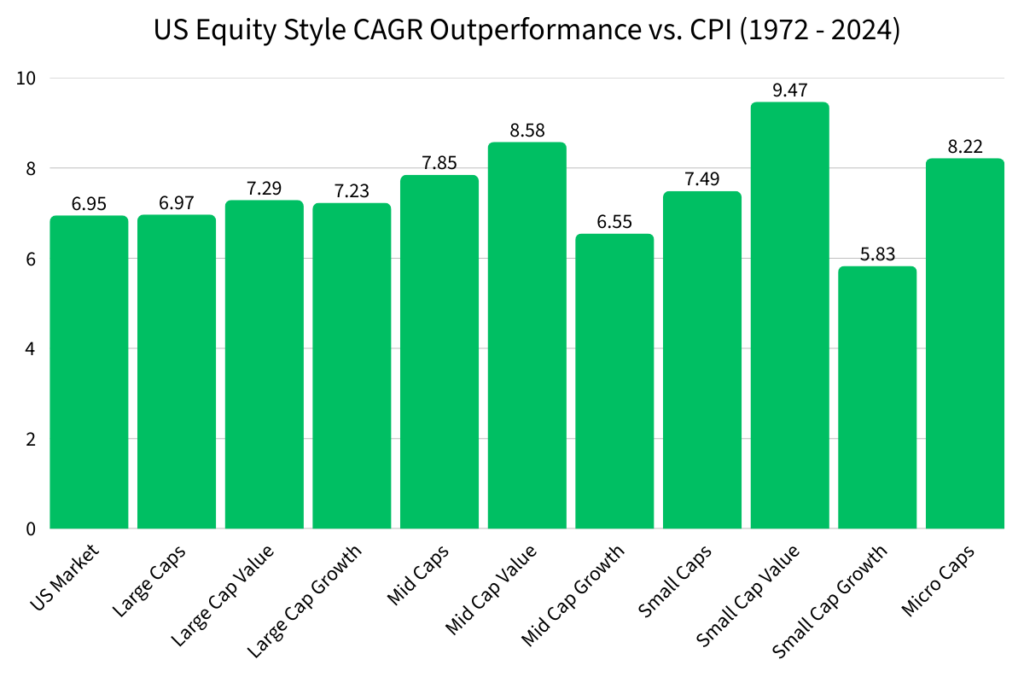
Every single US equity style beat CPI. That’s the good news.
US Equity Styles Compared to M2 Money Supply
Beating inflation is one thing. But there’s another way your wealth can get eaten away: the growth of the money supply.
The M2 Money Supply tracks how many dollars exist in the economy. When more money is created, your existing dollars become worth less.
From 1972 to 2024, the M2 Money Supply grew at a CAGR of 6.63% per year.
If your investments couldn’t beat that, you were losing ground in real terms, even if your nominal returns were increasing.
Here’s how each US equity style performed against M2.
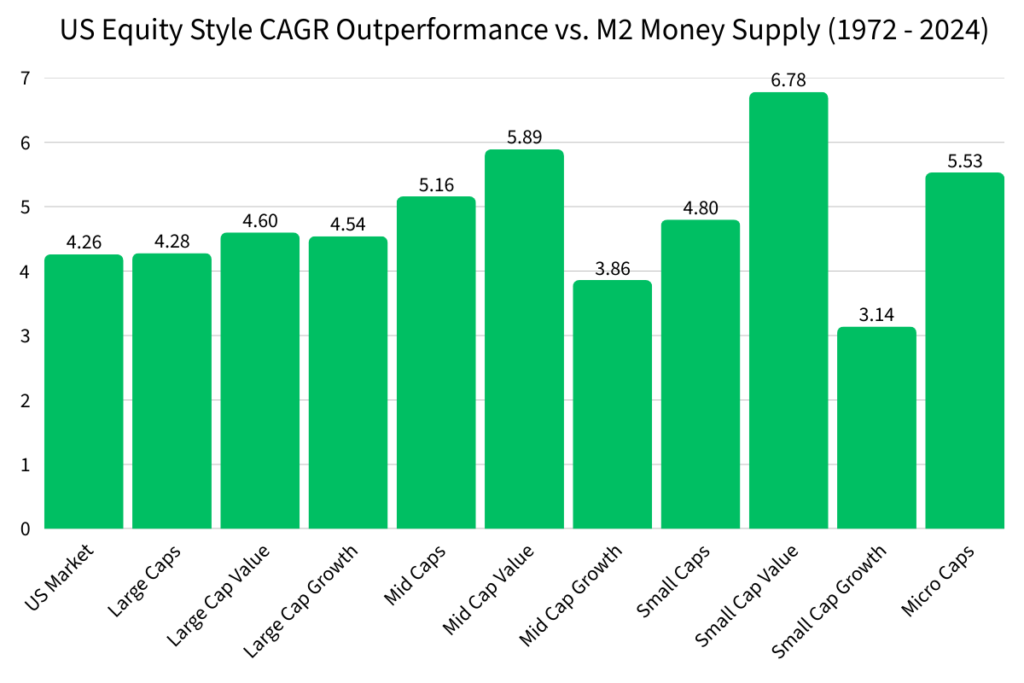
Each US equity style outperformed M2, meaning that real wealth was actually created. However, notice the difference between the nominal returns of each US equity style versus the returns adjusted for M2 growth.
| US Equity Style (1972 to 2024) | Performance vs. CPI | Performance vs. M2 |
|---|---|---|
| US Market | 6.95% | 4.26% |
| Large Caps | 6.97% | 4.28% |
| Large Cap Value | 7.29% | 4.60% |
| Large Cap Growth | 7.23% | 4.54% |
| Mid Caps | 7.85% | 5.16% |
| Mid Cap Value | 8.58% | 5.89% |
| Mid Cap Growth | 6.55% | 3.86% |
| Small Caps | 7.49% | 4.80% |
| Small Cap Value | 9.47% | 6.78% |
| Small Cap Growth | 5.83% | 3.14% |
| Micro Caps | 8.22% | 5.53% |
What This Means for You as an Investor Today
A 52-year track record is useful, but it can hide a lot. The economy in the 1970s looks nothing like the economy today. Treating them as one big average can be misleading.
That’s why it helps to think about US equity style returns in three distinct eras:
Era 1: Post-Gold Standard to 100% Debt-to-GDP (1972–2012)
A long stretch of growth, rising debt, and shifting monetary policy.
Read more: US Equity Style Returns from 1972 to 2012
Era 2: Low Interest Rates and ~100% Debt-to-GDP (2013–2020)
The era of cheap money, where growth stocks thrived.
Read more: Equity Returns during the ZIRP era
Era 3: Over 120% Debt-to-GDP (2020–Present)
A new environment that may favor different strategies entirely.